
It's not just men.
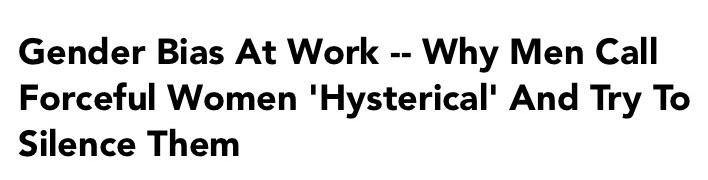
These headlines are just a few of many focused recently on the role of gender bias in the workplace. But are these headlines capturing the truth behind the bias? Several studies indicate that men are not alone in their unconscious bias negatively affecting women in the workplace. In fact, women themselves can have strong implicit biases against other women at work.
It’s important to recognize, for both men and women, that implicit bias is, literally, implicit, meaning unconscious, unintentional, and instinctive. It is hard wired in the brain from an early age. Mahzarin Banaji, the Richard Clarke Cabot Professor of Social Ethics at Harvard University and creator of six of the original “implicit association tasks” used for international research by Project Implicit, explains that humans prefer the easy, unconscious answer, allowing our brains to reach conclusions quickly, often without our even realizing it.
[Side note: Several respected researchers have criticized “Project Implicit” for failing to fulfill basic scientific research standards. Even the creators of Project Implicit say that the correlation between implicit bias, as measured by its online tool, and discriminatory behavior appears weaker than previously thought. They also conclude that there is very little evidence that changes in implicit bias have anything to do with changes in a person’s behavior. These issues are discussed in detail here, here, and here.]
According to these researchers, our hidden biases run the gamut of race, religion, weight, class, disability, and more. But of particular interest for this discussion is that of gender, and more specifically, of the gender biases that women themselves may consciously or unconsciously hold regarding other women.
Most working women have, at some point, dealt with a difficult female boss or supervisor. For Shannon, a young female associate at an unnamed large law firm who detailed her experience in an article for The Atlantic: “Women seem to cut down women.” While the idea of “mean girl” bosses is certainly not new, have we ignored the possible role of implicit bias in this disheartening tradition? Shannon felt the female partners at her firm were resentful of women coming behind them because of the difficulties they themselves faced when they were young associates. “There’s hostility among the women who have made it,” she said. “Its like, ‘I gave this up. You’re going to have to give it up too.’” Is part of this apparent resentment that these women had to work harder and make sacrifices to overcome gender biases? Are they now perpetuating the problem by having the same expectations? Are they requiring female associates to “earn” their positions the way they may have, instead of making it a better path?
One study asked participants to attribute the accomplishments of men and women to either ability or luck, depending on the area of the accomplishment. For men who were successful in a stereotypically male area (work, career, ambition), both male and female participants attributed the success to ability. But for women who were successful in the same types of areas, their successes were attributed to luck. Another STEM study found that women had to have 2.5 times the accomplishments on their resumes to be viewed as positively as men. Could the hostile female partners Shannon experienced be overcompensating for their own fear that their successes will be seen by others as luck, rather than the fruits of hard work? Alternatively, could they be perceiving younger women’s successes as based on luck or a more woman-friendly environment than they had, and subconsciously punishing women for it? Whatever the underlying motivation, do women’s own biases perpetuate the requirement that women must work harder, longer, and give up more, to be seen as equals of their male counterparts?
Hopefully, you don’t identify yourself as one of these “mean girl” bosses, and hopefully you’ve never had to experience such a situation in your own career. But chances are, you have experienced some hostility instead of mentorship from women in authority in the workplace.
As they say of many internal struggles, recognition is the first step. In case you would like to examine your own potential for implicit bias (it’s cool, don’t worry), head over to www.implicit.harvard.edu and click the link to “take a test.” The site allows you to test your own implicit bias reactions across a wide range of topics, including gender. Even if the implicit bias measured by this test does not predict discriminatory actions, it may cause you to reflect on your own actions and recognize that women, as well as men, can be biased against women. It may also cause you to consider how bias might play out in your own decisions. Mindfulness goes a long way toward making improvements. Let’s start a discussion to help ourselves, and those women coming behind us, to create a more equal playing field. What can we do to change or compensate for the biases we carry against other women? Check back for a future FOCUS post to further this conversation and for concrete ideas of how we can accomplish this work.
Also on Sharpen Your FOCUS: Perspectives on Workplace Diversity
Sharpen Your FOCUS offers timely insights into the legal and practical dimensions of DEI, accessibility, and belonging in the workplace. Drawing from both employer and employee perspectives, we explore emerging topics, shifting legal interpretations, and the real-world impact of inclusive leadership. Thanks for joining the conversation.