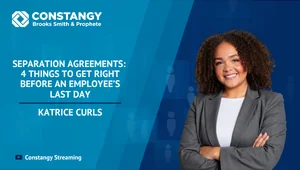
Constangy Clips Ep. 20 - Separation Agreements: 4 Things to Get Right Before an Employee’s Last Day
Separation agreements can feel routine, but overlooked details can leave employers exposed to the very claims the agreement was intended to resolve. An agreement template that complied with applicable federal and state laws when it was drafted may not reflect current requirements, making it important for employers to review separation agreements carefully before an employee’s departure.
In this episode of Constangy Clips, associate attorney Katrice Curls shares four practical tips to help employers prepare enforceable separation agreements, address federal and state law requirements, and avoid common mistakes before an employee’s last day.
What Consideration Is Required for a Separation Agreement?
For a separation agreement to be enforceable, the employee generally must receive something of value that they are not already entitled to receive. Katrice explains why final wages, earned commissions, or other compensation already owed to the employee may not provide sufficient consideration for a release of claims. Employers should identify what the employee is already owed and ensure the separation agreement provides something additional.
How Can State Laws Affect Separation Agreements?
The enforceability of provisions such as non-compete, non-disclosure, and non-disparagement clauses can vary significantly by jurisdiction. Katrice discusses differences between states, including restrictions on employee non-competes in California and requirements affecting certain non-compete agreements in Florida. She also highlights New York restrictions involving certain confidentiality and non-disparagement provisions related to discrimination and harassment claims.
Employers should determine which laws apply to a departing employee and tailor separation agreements to the applicable jurisdictions rather than relying on a one-size-fits-all template.
What Are the OWBPA Requirements for Employees Age 40 or Older?
When an employee is age 40 or older, a separation agreement must comply with the federal Older Workers Benefit Protection Act (OWBPA) for the employer to obtain a valid waiver of claims under the Age Discrimination in Employment Act (ADEA).
Katrice reviews several important OWBPA requirements, including applicable consideration periods, the employee’s right to consult with an attorney, specific language concerning the waiver of ADEA claims, and the seven-day revocation period. She also explains why employers need to determine whether a termination is an individual termination or part of a group termination, which can trigger additional requirements.
Can Separation Agreements Restrict Employees from Communicating with Government Agencies?
Federal and state laws may protect an employee’s ability to file administrative charges or communicate with government agencies, including the U.S. Equal Employment Opportunity Commission and the National Labor Relations Board. Katrice explains why separation agreements should include appropriate language preserving these rights rather than improperly restricting an employee’s ability to communicate with government agencies.
Key Takeaways for Employers
- Confirm that the employee receives adequate consideration beyond compensation or benefits already owed.
- Review applicable state and local laws before using non-compete, non-disclosure, non-disparagement, or similar provisions.
- Determine whether OWBPA requirements apply when an employee is age 40 or older.
- Identify whether a termination is an individual or group termination for purposes of applicable age-discrimination waiver requirements.
- Account for the OWBPA's seven-day revocation period when determining the timing of separation payments.
- Preserve employees’ legally protected rights to file administrative charges and communicate with government agencies.
- Review separation agreement templates regularly rather than assuming previously compliant language remains appropriate.
Related Resources
- Constangy Webinar: When Termination Becomes Litigation Risk: Using Severance Strategically
- Older Workers Benefit Protection Act Blog: Age law saves employer in lawsuit having zero to do with age
- Separation Agreements Blog: Bad luck for this employer with separation agreement
- Employment Litigation Prevention & Defense Practice Group
- More Constangy Clips Episodes
About Constangy Clips
Constangy Clips is a video series featuring practical guidance for employers on labor and employment law developments, workplace compliance issues, cybersecurity concerns, and HR best practices.
About Katrice Curls
Katrice Curls is an employment attorney in Constangy's Jacksonville office. She represents employers in workplace disputes and advises clients on labor and employment matters, including discrimination, wrongful termination, workplace compliance, employment agreements, and other complex employment issues.